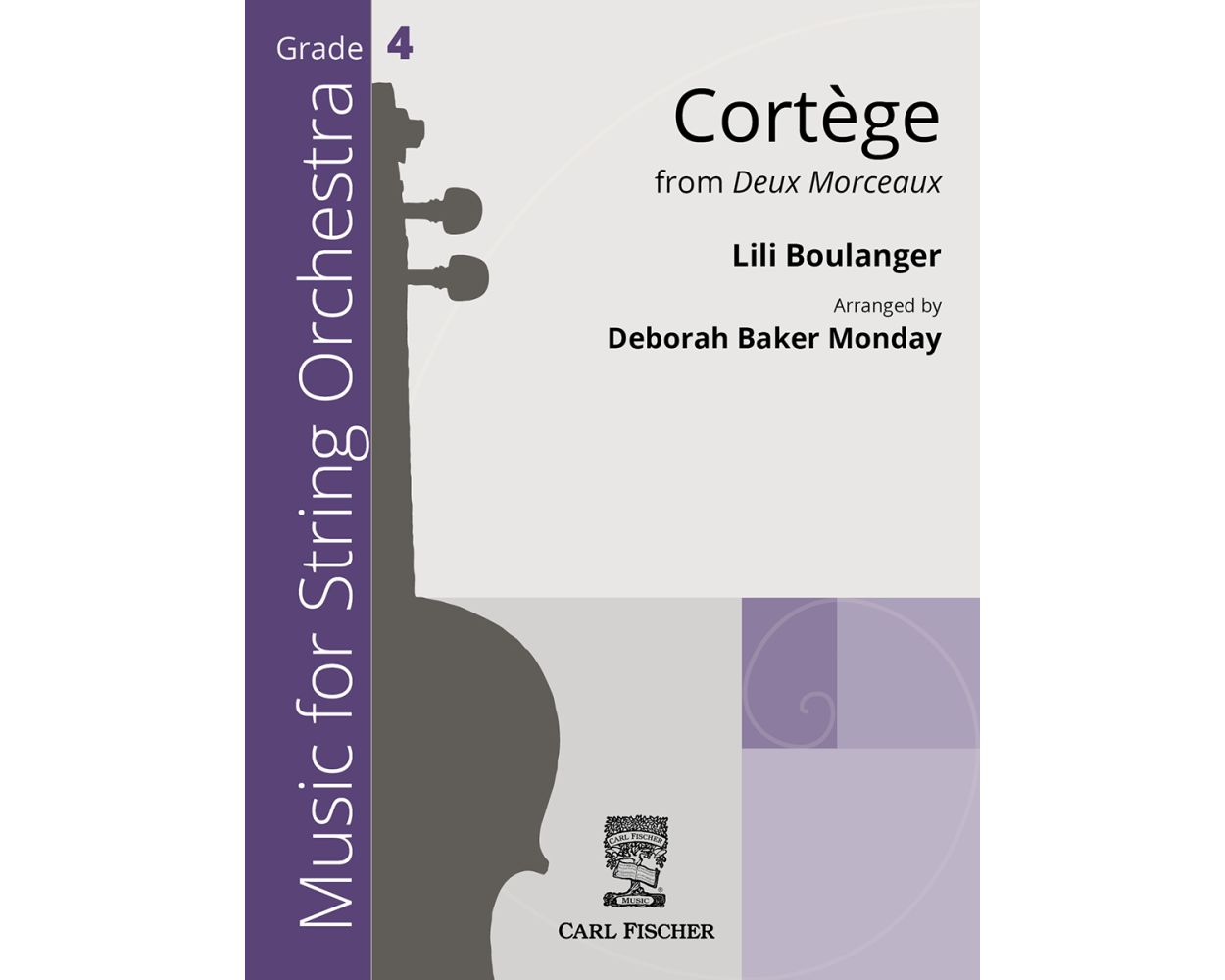
Lili Boulanger (1893–1918) was a gifted French composer whose amazing talent became evident at an early age. Cortège is the third movement in “Trois Morceaux,” a set of pieces first composed for solo piano, but later arranged for violin and piano by the composer. Some of Lili’s writing idioms appear in Cortège such as harmonic shifts, free use of chromatics, and even subtle use of a whole tone scale. A cortege is a kind of procession, sometimes for a funeral, but in this case the procession is more upbeat and cheerful.
Lili Boulanger (1893–1918) was a gifted French composer whose amazing talent became evident at an early age. Cortège is the third movement in “Trois Morceaux,” a set of pieces first composed for solo piano, but later arranged for violin and piano by the composer. Some of Lili’s writing idioms appear in Cortège such as harmonic shifts, free use of chromatics, and even subtle use of a whole tone scale. A cortege is a kind of procession, sometimes for a funeral, but in this case the procession is more upbeat and cheerful.
Lili Boulanger (1893–1918) was a gifted French composer whose amazing talent became evident at an early age. Cortège is the third movement in “Trois Morceaux,” a set of pieces first composed for solo piano, but later arranged for violin and piano by the composer. Some of Lili’s writing idioms appear in Cortège such as harmonic shifts, free use of chromatics, and even subtle use of a whole tone scale. A cortege is a kind of procession, sometimes for a funeral, but in this case the procession is more upbeat and cheerful.
Lili Boulanger (1893–1918) was a gifted French composer whose amazing talent became evident at an early age. Cortège is the third movement in “Trois Morceaux,” a set of pieces first composed for solo piano, but later arranged for violin and piano by the composer. Some of Lili’s writing idioms appear in Cortège such as harmonic shifts, free use of chromatics, and even subtle use of a whole tone scale. A cortege is a kind of procession, sometimes for a funeral, but in this case the procession is more upbeat and cheerful.
Lili Boulanger (1893–1918) was a gifted French composer whose amazing talent became evident at an early age. Cortège is the third movement in “Trois Morceaux,” a set of pieces first composed for solo piano, but later arranged for violin and piano by the composer. Some of Lili’s writing idioms appear in Cortège such as harmonic shifts, free use of chromatics, and even subtle use of a whole tone scale. A cortege is a kind of procession, sometimes for a funeral, but in this case the procession is more upbeat and cheerful.